
Tattoo Aftercare!
At Arvada Tattoo Collective, this is our recommended aftercare for both standard healing and second skin methods. Every artist has their own preferences, and these guidelines reflect what we recommend for the best, healthiest results. If you ever have any questions or concerns during your healing process, don’t hesitate to message your artist directly or call/text the shop anytime at 303-918-7827 — we’re always happy to help you take care of your new tattoo.

Traditional Aftercare Instructions!
Leave your bandage on for at least 2–4 hours after your tattoo is finished. This helps protect your fresh tattoo from bacteria and airborne contaminants. Once you remove the bandage, wash your hands first, then gently wash your tattoo with warm water and mild, unscented soap (like Dial or Dr. Bronner’s). Do not use a washcloth, loofah, or anything abrasive — use only your hands.
Pat the area dry with a clean paper towel or let it air dry. Do not rub. After washing, apply a thin layer of Aquaphor or a tattoo-specific healing ointment (such as Hustle Butter, Redemption, or Tattoo Goo). A little goes a long way — too much ointment can clog pores and delay healing.
Continue washing and applying ointment 2–3 times a day for the first 3–4 days. After that, switch to a fragrance-free lotion (like Lubriderm, Aveeno, or Eucerin) as needed to keep the tattoo moisturized. Avoid petroleum jelly, Neosporin, or anything with heavy fragrance or alcohol.
Your tattoo will begin to peel and flake like a sunburn — this is normal. Do not pick, scratch, or peel the scabs or flakes, as doing so can pull out ink and cause scarring. Let everything fall off naturally.
Avoid soaking your tattoo in water for at least two weeks. This includes swimming pools, hot tubs, lakes, and baths. Quick showers are fine. Avoid direct sunlight and tanning beds until your tattoo is fully healed. Once healed, always use sunscreen to protect your tattoo and preserve the colors.
Wear clean, loose-fitting clothing over the area while it heals. Avoid tight, dirty, or abrasive fabrics that could rub against the tattoo.
If you notice excessive redness, swelling, pus, or other signs of infection, contact your artist or a healthcare professional immediately.
Your tattoo should be mostly healed in 2–3 weeks, but full healing can take up to a month depending on the placement and your skin type.
Take care of your tattoo — it’s a lifetime investment in your skin!
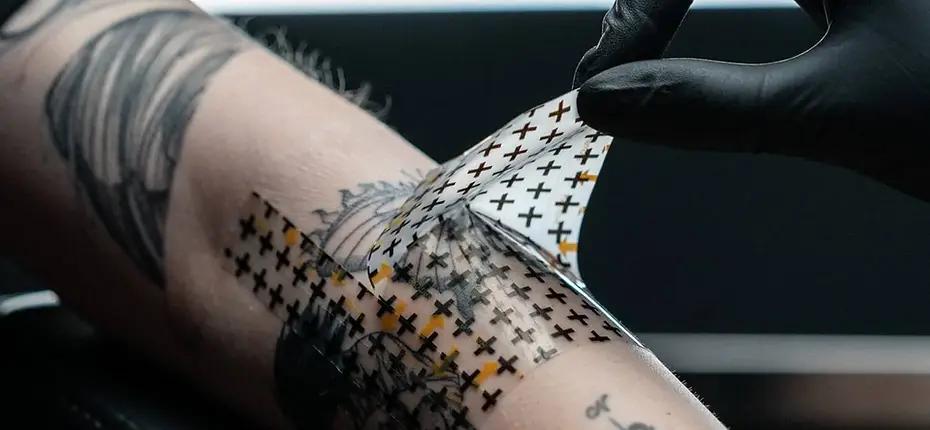
Recovery and 2nd Skin Aftercare!
If your artist used Second Skin, Saniderm, or another dermal film bandage, your tattoo is already sealed and protected. Keep this bandage on for 3–5 days, depending on how much fluid builds up underneath. It’s normal to see plasma, ink, and a bit of blood collect — it can look cloudy or dark under the film.
If the bandage fills up or starts to leak before the 3–5 day mark, gently remove it early. To remove the film, do so slowly under warm running water, pulling it back over itself rather than straight up from the skin. Take your time and be gentle.
Once removed, wash the tattoo thoroughly with mild, unscented soap and warm water, using only your hands. Pat dry with a clean paper towel or let it air dry — do not rub.
For the next few days, apply a thin layer of fragrance-free lotion (such as Lubriderm, Aveeno, or Eucerin) as needed to keep the tattoo moisturized. Avoid petroleum jelly, Neosporin, or heavy ointments.
Do not reapply another bandage unless instructed by your artist. Let the tattoo breathe and heal naturally. Avoid soaking, swimming, tanning, or direct sunlight for at least two weeks.
Peeling and flaking are normal parts of the healing process. Do not pick or scratch your tattoo. Allow the skin to shed naturally.
If you experience excessive redness, swelling, or irritation beyond mild soreness, contact your artist or a healthcare professional.
Things to Look out for!
During the healing process, your tattoo will go through a few normal stages — light redness, mild tenderness, and flaking are all part of it. However, here are a few things to keep an eye on and contact your artist or a healthcare professional about if they happen:
Excessive Redness or Swelling – Some redness is normal for the first couple of days, but spreading redness, heat, or puffiness can signal infection or irritation.
Thick, Yellow, or Green Discharge – A thin layer of clear plasma is normal, but thick or colored fluid with a foul smell isn’t.
Rash, Itching, or Burning – Mild itching means healing, but rash-like bumps, severe burning, or allergic reactions can mean your skin is reacting to a product or the bandage.
Severe Pain or Throbbing – A tender tattoo is fine, but if the area becomes very painful or starts throbbing days after getting tattooed, it’s worth checking in.
Fever or Chills – If you start feeling sick, develop a fever, or notice streaking redness moving away from the tattoo, contact a medical professional right away.
If you’re ever unsure whether something looks right, message your artist or call/text the shop — it’s always better to double-check than to worry.
